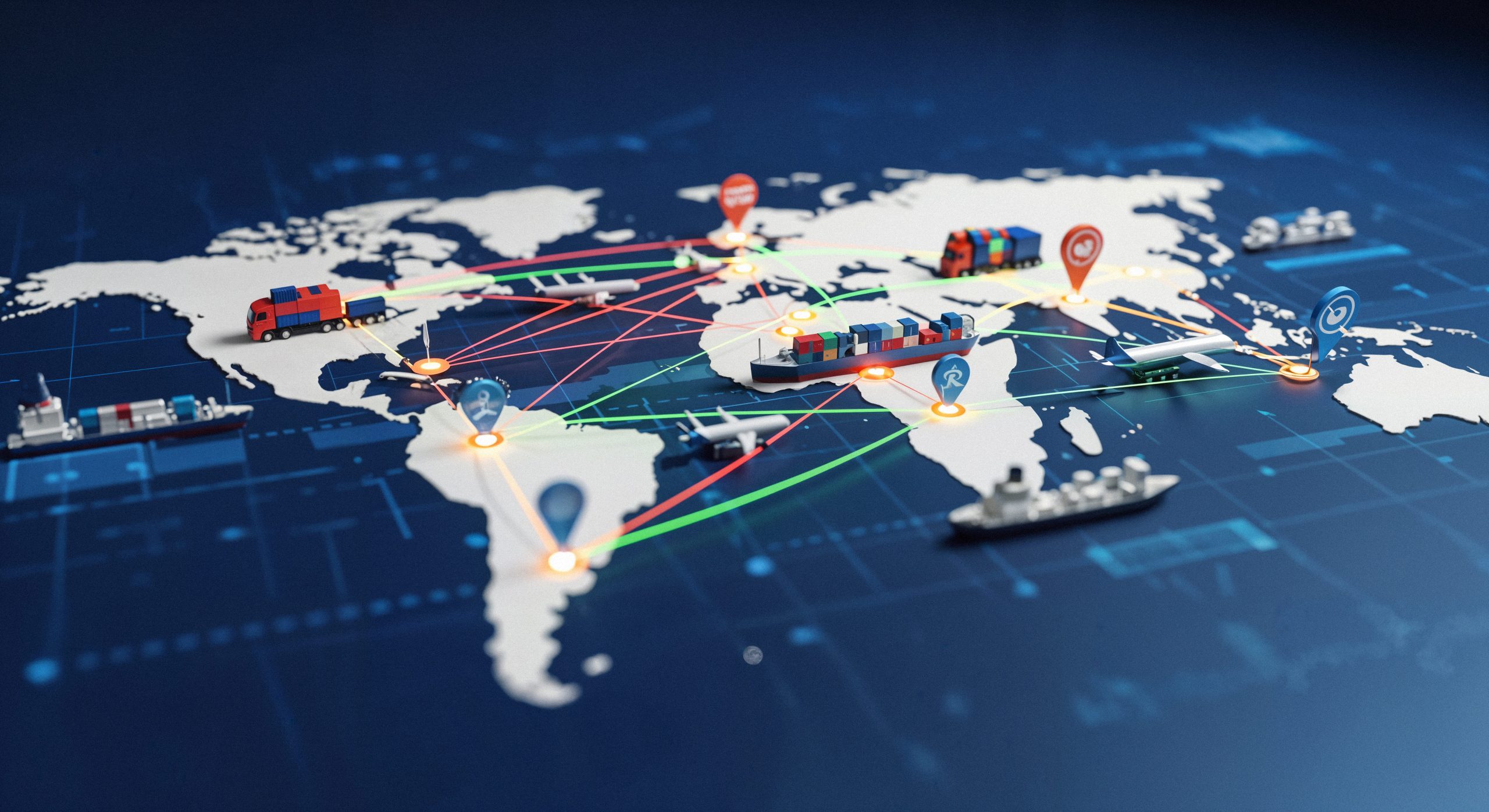
A 40-foot container loaded with electronic components has been stuck at the Port of Rotterdam for three days. The reason? An error in the translation of an HS (Harmonized System) code on the customs declaration triggered an extraordinary inspection. The Chinese supplier used a different product classification from the one agreed upon, causing a hold-up that will cost the importing company more than €15,000 in delays and penalties.
This is not a hypothetical scenario but an everyday reality in global supply chains. When supply networks involve dozens of countries, hundreds of suppliers, and thousands of technical documents, terminology is not merely a linguistic matter but a critical factor that directly affects costs, delivery times, and regulatory compliance.
The Invisible Problem: When Terms Are More Than Just Words
Supply chain management operates through a highly codified and specialized language. We are talking about Incoterms, Harmonized System codes, specific customs terminology, international logistics abbreviations, and transportation management acronyms. This technical vocabulary leaves no room for interpretation or approximation.
Paradoxically, the same concept can be expressed in different ways even within the same language. In Italian, for example, “supply chain” may be translated as catena di approvvigionamento, catena di fornitura, filiera, or simply left in English. This lack of consistency creates operational confusion: a buyer may refer to “lead time,” a logistics manager to “delivery time,” and a manufacturer to “throughput time,” all essentially referring to the same concept while generating misunderstandings within business processes.
In regulatory and customs contexts, where precision is essential, more than 75% of companies report difficulties in maintaining consistent international standards, primarily due to regulatory fragmentation. When a technical term is misinterpreted and results in non-compliant documentation, the consequences include customs holds, administrative penalties, and delays that ripple throughout the entire supply chain.
Critical Challenges in Global Communication
Language barriers are only the tip of the iceberg. When Asian suppliers, European manufacturers, and American distributors collaborate, linguistic and cultural differences complicate communication and the understanding of local requirements. Simply translating a technical term is not enough; organizations must interpret the context, understand local regulatory implications, and ensure that every stakeholder in the supply chain shares the same operational understanding.
Another critical issue concerns data quality and alignment across legacy systems, cloud platforms, IoT sensors, and departmental tools that do not communicate with one another. This technological fragmentation makes it difficult to maintain consistent terminology glossaries. A company may have an ERP system that uses one set of codes, a Warehouse Management System (WMS) with different naming conventions, and Transportation Management Systems (TMS) that introduce further variations for the same concept.
The lack of internal standardization further exacerbates the problem. Many organizations do not maintain centralized termbases or shared terminology databases. Each branch, department, and partner may use slightly different terminology, creating a corporate Tower of Babel in which the same operation is described in multiple ways.
Incoterms: The Perfect Example of Critical Terminology
Incoterms (International Commercial Terms) are perhaps the clearest example of how standardized technical terminology is essential to global operations. Published and regularly updated by the International Chamber of Commerce, these eleven trade terms precisely define responsibilities, costs, and risks between sellers and buyers in international transactions.
We are talking about acronyms such as EXW (Ex Works), FCA (Free Carrier), FOB (Free On Board), CIF (Cost, Insurance and Freight), DAP (Delivered At Place), and DDP (Delivered Duty Paid). Each acronym precisely defines where responsibility begins and ends, who pays for transportation, who handles insurance, and who manages customs procedures.
Incoterms are globally recognized and accepted by governments, customs authorities, and courts around the world. However, their value is fully realized only when all supply chain stakeholders, from buyers and freight forwarders to customs brokers and logistics managers, understand and apply them correctly. For detailed specifications and the latest updates, the International Chamber of Commerce provides comprehensive official resources.
Technology and Terminology Management: Solutions That Work
Leading companies in global supply chain management have developed precise technological strategies to address terminology challenges. Terminology databases and termbases form the backbone of this approach. Specialized software centralizes multilingual corporate glossaries by associating terms with metadata, usage guidelines, contextual information, and relationship mapping, enabling more targeted and effective searches across target languages.
Translation Management Systems (TMS) ensure consistency in technical translations. By reusing previous translations and repetitive content, these systems accelerate translation workflows and maintain client-specific terminology for accurate results. Translation memories ensure that once a technical term has been validated, it is translated consistently across all future documents.
The most advanced organizations take a proactive approach by identifying new terminology during the product or process development phase, before localization begins and in close collaboration with technical teams. This model, widely adopted by large international organizations, contrasts with the traditional reactive approach in which terminology is documented only after a translation issue emerges.
Integration with supply chain management platforms is equally critical. Modern platforms function as multichannel web layers integrated with corporate ERP systems, harmonizing data from different sources. Shared dashboards allow all stakeholders to view the same terminology, reducing ambiguity and accelerating decision-making processes.
Artificial intelligence is also playing an increasingly important role in technical translation, with neural engines trained on industry-specific terminology. However, human intervention remains indispensable. Only experienced professionals can guarantee quality, cultural adaptation, and regulatory compliance. Technology accelerates and standardizes processes, but final validation still requires specialized human expertise.
Best Practices for Supply Chain-Proof Terminology
Creating and maintaining centralized glossaries is the essential first step. Every company operating internationally should maintain shared termbases accessible to all departments and, where appropriate, to strategic supply chain partners. These glossaries are not simple lists of translations but dynamic tools that include definitions, usage contexts, practical examples, and approved variations.
Team training is often underestimated. Not only professional translators but also buyers, logistics managers, customs specialists, and customer service representatives must understand the sector’s critical terminology. Investing in internal workshops on technical terminology, Incoterms, and customs codes reduces costly mistakes and accelerates operational processes.
Standardizing terminology validation processes means documenting clear procedures for introducing new terms into target languages. Who has the authority to validate a technical translation? How are regional variations of the same term managed? What criteria determine the preferred translation among several alternatives? Answering these questions through documented policies prevents arbitrary decisions and inconsistencies.
Collaboration with qualified partners is equally essential. Certified customs brokers, translators specialized in industrial and logistics documentation, and consultants with sector-specific expertise can make the difference between a smooth shipment and a customs blockage lasting weeks.
Regular monitoring and terminology audits of operational documents help identify inconsistencies before they become costly problems. Quarterly reviews of critical documents, such as customs declarations, supplier contracts, and technical specifications, ensure that terminology remains compliant and consistent over time.
Investing in technology without neglecting the human element represents the winning balance. Managing technical terminology consistently not only improves understanding but also strengthens corporate reputation. Advanced software, artificial intelligence, and automation accelerate processes, but specialized human expertise remains essential for cultural adaptation, regulatory interpretation, and exception management.
Conclusion
Technical terminology in global supply chains is far more than a detail confined to translation activities. It is a strategic asset that determines competitiveness, operational efficiency, and regulatory compliance for companies operating internationally.
In an environment where supply chains are becoming increasingly complex, interconnected, and subject to stringent regulations, effective terminology management translates directly into reduced operational risks, optimized quality-related costs, and improved compliance across diverse markets.
A final question to consider: does your company maintain a centralized and regularly updated terminology glossary? Do your international partners, including suppliers, carriers, and customs brokers, truly speak the same technical language when it comes to Incoterms, HS codes, and customs documentation? In a world where a single misunderstood term can stop a container, the answer to these questions is worth far more than it may seem.
Aglatech14 ContenTalkers