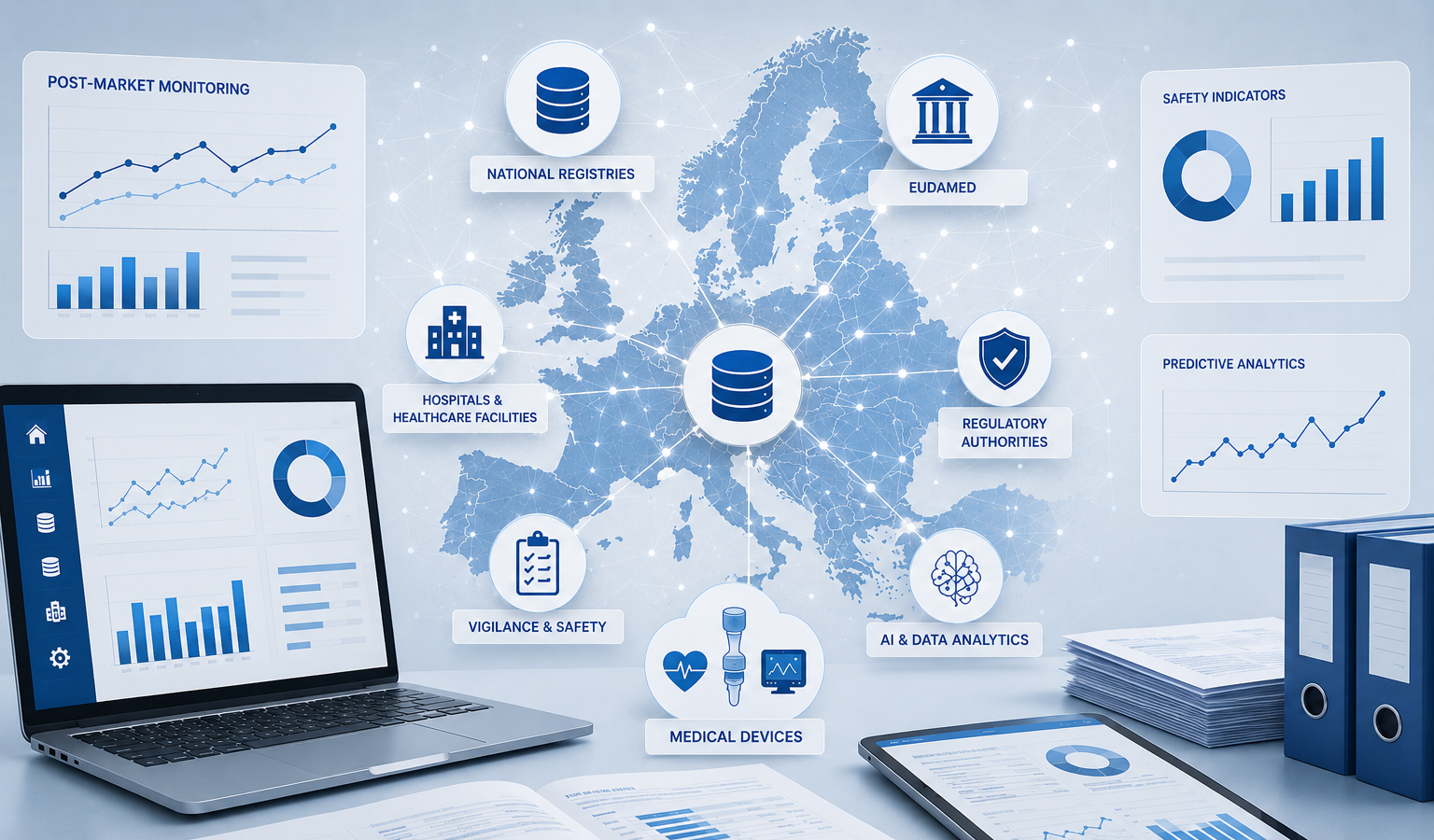
The year 2026 marks a turning point for the medical device sector. As of this year, EUDAMED is fully operational for its first four modules, the European Commission has presented its proposal to revise the MDR and IVDR Regulations, and national databases are evolving towards increasingly integrated governance-oriented architectures. Completing this picture, artificial intelligence has officially entered the sector’s monitoring and analysis systems, helping transform the way information is collected, interpreted and used.
A new phase is emerging in which the availability and interpretation of data increasingly influence healthcare policy decisions. In this context, the quality of the information being recorded, classified and communicated is becoming more important than ever, with implications for planning, vigilance activities and health technology assessment.
Registries Are Not Archives: They Are Governance Tools
In the debate surrounding medical device governance, registries are playing an increasingly significant role. These are structured systems designed to collect and analyse data relating to specific categories of devices or clinical pathways, with the aim of monitoring their use, safety, effectiveness and outcomes over time. Implantable device registries, in particular, because of their substantial clinical and economic impact, are now considered strategic healthcare governance tools, supporting not only traceability but also outcome evaluation, healthcare planning and public decision-making processes.
These systems are used to assess long-term outcomes, support Health Technology Assessment (HTA), guide reimbursement decisions and optimise public spending, operating as living systems fuelled by real-world data and real-time data. A concrete example is the Italian Breast Implant Registry, established by Law No. 86/2012 and made mandatory through Ministerial Decree No. 207/2022. As the first mandatory national registry dedicated to an implantable medical device, its official objectives include clinical monitoring to prevent complications, rapid patient traceability, and epidemiological surveillance to evaluate effectiveness and safety in both the short and long term.
The scale of the phenomenon is reflected in the national medical device vigilance network, which manages nearly 10,000 reports each year involving incidents, malfunctions, complaints and corrective actions related to medical devices and in vitro diagnostic devices (IVDs). This number continues to grow, demonstrating how the issue encompasses clinical, organisational, economic and regulatory dimensions. And, as we shall see, linguistic ones as well.
AI Enters the Picture: Powerful, but Not Infallible When It Comes to Language
The Italian Ministry of Health has begun using artificial intelligence to correlate consumption data, procurement contracts, Essential Levels of Care (LEA), and contract award price monitoring. The objective is not to automate clinical decisions, but to build a governance system capable of identifying complex signals in real time and responding more quickly and effectively.
This represents a tangible shift, but it also raises a crucial issue: in healthcare and regulatory environments, data is never just data. Specialist terminology, classifications and definitions continuously evolve and can take on different meanings depending on the regulatory framework in which they are used.
The introduction of the new national CID classification system (Classification and Identification of Devices), intended to replace the current National Classification of Medical Devices (CND), is a clear example. For this reason, we believe that the effectiveness of AI cannot be separated from robust terminology governance and qualified linguistic oversight. Only in this way can consistency, reliability and the correct interpretation of information be ensured throughout the entire data lifecycle.
One of the structural challenges most frequently cited by industry stakeholders concerns divergent interpretations among national authorities. Ultimately, this is also a language issue, because certain concepts do not travel in the same way from one legal system to another, from one language to another, or from one classification framework to its successor.
Linguistic Register as a Strategic Variable
The concept of linguistic register, namely the ability to adopt the appropriate tone, terminology and level of formality for a specific context, is becoming a critical competency for professionals working in the medical device sector. Regulatory documentation, databases, classifications and guidance documents all require a level of linguistic precision that leaves no room for approximation.
An inaccurate translation of a device classification, a term rendered inconsistently between Italian and European guidance documents, or a slightly altered definition within an implementation act can generate operational, legal and, in the worst cases, clinical consequences.
This need for precision applies across all key communication areas within the sector:
- Documents submitted to competent authorities and notified bodies, where any inaccuracy may result in delays or non-compliance.
- Manufacturers’ technical documentation, which must remain consistent and verifiable in every part.
- Translations of European regulations and guidance documents, where approximate equivalence may alter the original legal meaning.
- Content intended for healthcare professionals and patients, which requires a different register but no less linguistic control.
A Practical Example: When Compliance Depends on Terminology
The importance of terminological control becomes particularly evident in large-scale regulatory translation projects. One project managed by Aglatech14 involved translating the technical documentation of an Italian manufacturer specialising in infection control solutions into 22 European Union languages, in compliance with MDR 2017/745. The project included user manuals intended for physicians and healthcare professionals and required continuous updates throughout the project lifecycle.
The challenge was not simply the number of languages involved, but above all the need to guarantee terminological consistency, regulatory compliance and documentary uniformity across all versions. To achieve this, a multidisciplinary team was coordinated using shared terminology management and quality assurance tools, bringing together specialised linguists and professionals with specific expertise in the regulatory field.
Projects such as this demonstrate that, within the medical device sector, linguistic quality is not an accessory element of compliance; it is one of its essential components.
Finding the Balance: AI and Specialist Review Working Together
It would be a mistake to position artificial intelligence and human expertise as opposing forces. The sector does not need this oversimplification, and the market has already recognised that. AI is a powerful tool for processing large volumes of regulatory text, identifying patterns in vigilance data and accelerating document management. However, terminological consistency, sensitivity to legal context and the ability to distinguish intentional ambiguity from drafting inaccuracies still require expert human intervention that cannot be replaced by processing speed alone.
The most effective combination is AI plus specialised review: the speed of automated processing combined with the precision of professionals who understand how to interpret a European regulation within its proper context and transfer it into another language or format without losing meaning along the way. This is the post-editing model applied to high-risk documentation, ensuring that the intended meaning reaches its destination intact, together with all its legal and operational implications.
Why This Matters for Language Professionals in the Sector
The developments of 2026 confirm that the medical device industry is undergoing profound transformation. Manufacturers, consultants, specialised law firms and notified bodies are all managing increasing volumes of regulatory documentation across multiple languages and under ever more demanding standards.
In this environment, professionals who work with language, whether specialised translators, technical writers, legal linguists or scientific communicators, must be fully integrated into the compliance process, bearing direct responsibility for the quality and reliability of the content being produced.
In a system where data becomes governance, where registries become instruments of healthcare policy, and where AI analyses contracts and procurement prices in real time, the quality of what is written, translated and communicated has never been more strategic, nor more difficult to improvise.
Aglatech14 ContenTalkers