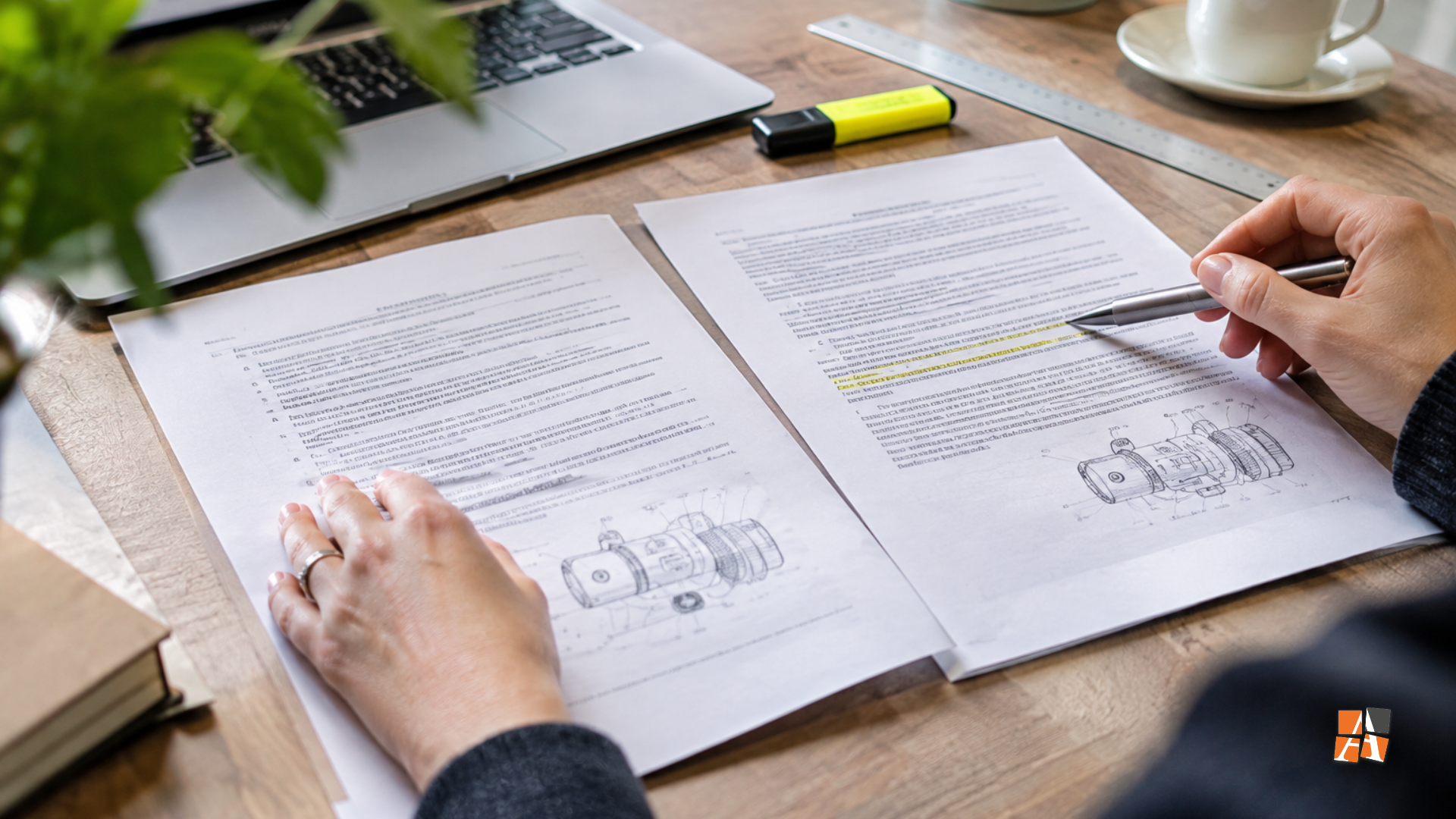
Patent claims translation is the stage at which a patent risks losing some of its value. Patent claims define what is protected and what remains freely available to others. A single mistranslated word can broaden or narrow the scope of protection. It can also create opportunities for competitors that should not exist. This is why translating claims is not simply an administrative formality to be completed as quickly as possible. It is a strategic decision that requires a combination of linguistic, technical and legal expertise.
What are patent claims and why are they so important?
The full description and drawings explain the invention. Claims, on the other hand, define its legal boundaries. They are the text that judges, patent offices and competitors examine to determine where the patent holder’s exclusive rights begin and end. Every term therefore carries specific weight: conjunctions, adverbs and verbs are not merely stylistic details, but determine the scope of protection.
A technical manual translator may have some freedom of expression, but a patent claims translator does not. The translator must reproduce exactly the same scope of protection in the target language, neither broadening nor narrowing it. At the same time, the translated text must remain a valid, clearly worded claim that complies with the conventions of the destination country.
A single conjunction can change everything
Just one word can be enough to change the scope of a patent. Consider a claim requiring two features together, connected by “and”. If that “and” becomes “or” in translation, only one of the two features is needed to fall within the scope of protection: the translated claim is broader than the granted claim. The opposite can also happen, resulting in narrower protection. In both cases, the translated text no longer reflects what the patent holder was granted.
The consequences of an error depend on its severity and the rules of the country in which the patent is enforced. A minor inaccuracy can often be corrected, whereas an error that changes the substance of a claim may compromise protection. This is why preventing mistakes is always preferable to correcting them.
Timing is also crucial. A correction submitted promptly, before competitors take action, may resolve the problem. A late correction does not undo actions already taken by third parties relying on the published text, and may come when it is already too late. This is why the difference between an accurate translation and an approximate one becomes particularly evident when a patent is challenged in court.
The most common translation errors
In practice, the most problematic errors are often the smallest. Here are some recurring examples:
- Logical connectors: “and”, “or” and “and/or” change the number of features required.
- Transitional phrases: “comprising” indicates an open-ended list, while “consisting of” indicates a closed list.
- Expressions of degree: “substantially”, “approximately” and “at least” affect the scope of protection in different ways.
- Terminological consistency: the same component must always be referred to by the same term; otherwise, references such as “said element” become unclear.
- Reference numerals: an incorrect number may link a claim to the wrong component.
Many of these errors go unnoticed during a quick review. They only emerge when a specialist carefully compares the two versions, or when a dispute is already under way. This is precisely what our quality checks are designed to prevent: they are structured, carried out by specialists and supported by our two ISO certifications. ISO 17100:2015 establishes the requirements for the translation process, including revision by a second linguist. ISO 18587:2017, meanwhile, governs the human post-editing of machine-translated texts.
Tight deadlines, long-lasting consequences
Time constraints make this stage even more critical. When the European Patent Office issues its intention to grant a patent, the applicant has four months to approve the text, file translations of the claims into the Office’s other two official languages and pay the relevant fees. Within this period, every decision must be carefully considered while also being made quickly.
The issue remains relevant under the Unitary Patent system. In the event of litigation, the patent holder may be required to provide, at their own expense, a full translation of the patent into the language of the Member State concerned. At that point, the quality of the translated text becomes a tangible element of the legal strategy.
How to choose a language service provider
Not all providers are suited to this type of work. Even an excellent generalist translation agency may lack the expertise and tools required to handle patent documents. Before assigning a project, it is worth checking several factors:
- Specialist expertise: translators with experience in both the technical field of the invention and patent terminology.
- Independent revision: a second specialist should compare the translation against the original, claim by claim.
- Consistency tools: glossaries and translation memories help maintain consistent terminology throughout the document and across patents belonging to the same family.
- Confidentiality: before publication, the content of a patent application is a valuable asset that must be protected through clear procedures and agreements.
- Communication with the patent attorney: translators must be able to request clarification on ambiguous points rather than resolving them independently.
- Transparent use of machine translation: if machine translation is used, it must be followed by qualified human post-editing.
How clients can improve the outcome
Clients commissioning translations can also make a significant contribution. It is advisable to share translations of previously filed patents belonging to the same family, any existing company glossaries and the complete drawings. It is also useful to specify the purpose of the translation: filing, information purposes for an office or potential litigation. Finally, sufficient time should be allowed for the work. A translation completed without unnecessary time pressure costs less than a correction made during legal proceedings.
In summary
Patent claims translation is not the final formality before grant. It is the stage at which years of research and patent drafting are transferred into another language and another legal system. Investing in the right expertise, independent revision and clear communication with the language service provider reduces the risk of errors. Above all, it protects what the patent was designed to safeguard: the value of the invention.
Aglatech14 ContenTalkers
Further reading
- EPO Guidelines for Examination, H-VI 5: Correction of the translations of the claims, the European Patent Office’s official guidance on the legal significance of patent claims translations.
- EPO, National Law relating to the EPC: Authentic text of a European patent application or European patent, an overview of which text is legally authoritative in the different contracting states.</WritingBlock