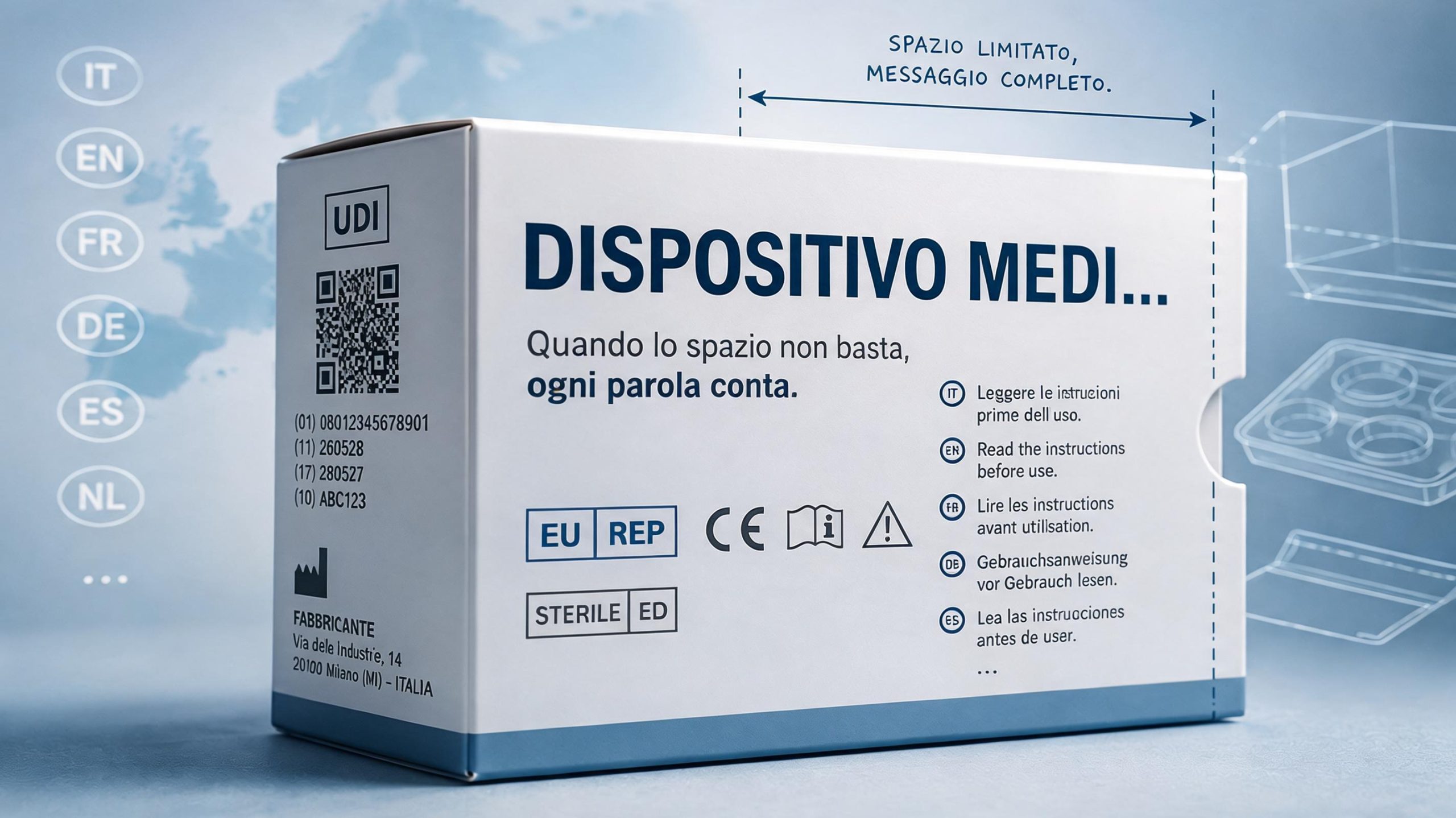
When people think about packaging, they almost always picture consumer products: aesthetics, branding and shelf appeal. In the world of medical device packaging, however, the perspective is completely different. The packaging is not an accessory but an integral part of the device itself. It must preserve sterility, withstand transportation, communicate critical information within just a few square centimetres, and do so while complying with regulations that are updated more frequently than many realise.
Behind every medical device package lie three closely connected elements that are rarely discussed together: the materials used to manufacture it, the European regulations it must comply with, and the language in which the required information is presented. These three aspects influence one another and should be considered together from the very beginning, not addressed one after another.
Sterile Barrier Systems: More Than Just “Containers”
In the medical device industry, a packaging system is designed to meet highly specific requirements. Examples include thermoformed trays for cleanroom environments, blister packs with Tyvek® lids to provide a complete microbial barrier, aluminium foil laminates for products sensitive to light or moisture, multi-panel cartons with inserts for package leaflets, and booklet labels used when the required information exceeds the available space on the primary packaging.
In practice, sealing these packages requires millimetre-level precision. If the film does not adhere perfectly, the device may lose its sterility before it even reaches the operating theatre. The way the package is opened is equally important. Medical-grade peelable films, commonly known as easy-peel materials, must separate cleanly and in a controlled manner, without leaving fibre residues that could contaminate the sterile field during a procedure.
The general requirements for packaging and sterility are defined internationally by ISO 11607, the reference standard for the design of packaging intended for terminally sterilised medical devices.
2026 Regulatory Updates Affecting Medical Device Packaging
From a regulatory perspective, 2026 is proving to be a particularly significant year for medical device packaging.
The New EU REP Symbol In June 2026, the European Commission published an update officially introducing the EU REP symbol to replace the previous EC REP symbol identifying the Authorised Representative. Although this may appear to be only a graphical change, it directly affects labels, instructions for use (IFUs), packaging and technical documentation. Manufacturers have a five-year transition period, allowing the new symbol to be incorporated into normal packaging revision cycles.
EUDAMED Becomes Fully Operational As of 28 May 2026, four key modules of the European EUDAMED database became mandatory. Manufacturers, authorised representatives and importers are now required to register economic operators, medical devices (including their UDI-DI) and certificates.
For companies managing packaging across multiple markets, this means that label information, UDI carriers and registration data must remain fully consistent across all commercialisation languages. Otherwise, the consequences may extend beyond regulatory non-compliance to customs delays or interruptions in product distribution.
ISO 15223-1 Symbols Help Optimise Space With the continued evolution of the harmonised EN ISO 15223-1 standard, which now includes 68 recognised symbols, many manufacturers are replacing text with standardised pictograms. This allows them to save valuable space on small packages without compromising regulatory compliance.
The overall regulatory framework remains the EU Medical Device Regulation (EU) 2017/745 (MDR), which also establishes the language requirements applicable to labels and instructions for use.
The Role of Language in Medical Device Packaging
This brings us to the aspect that matters most from a linguistic perspective. More importantly, however, it is an industrial process issue rather than simply a translation task.
A medical device marketed in Europe may require information in a selection of the 24 official EU languages, while each Member State defines its own rules regarding which information must be translated and whether it is intended for professional or lay users.
When all this information must fit onto a booklet label, a multi-panel carton or a tray whose available space has already been reduced by symbols, UDI codes and sterility warnings, the challenge is no longer simply producing an accurate translation. It becomes a matter of ensuring that the linguistic content fits within the physical constraints of the packaging.
Romance languages, for example, generally require more characters than English to express the same concept. This is a detail that packaging designers need to consider before finalising the artwork, not afterwards. It represents one of the most common points of friction between graphic design teams, regulatory affairs specialists and language professionals, and helps explain why an increasing number of medical device manufacturers rely on centralised terminology management and multi-level review workflows shared across different departments.
This is a reality we know well from practical experience. At Aglatech14, we regularly translate artwork for a company operating in the herbal and phytotherapy sector, producing food supplements, medical devices and plant-based natural cosmetics distributed across several European markets.
Our work goes far beyond translating the text. Depending on the content and target language, we frequently support the desktop publishing process as well, ensuring that the translated version fits the layout of the original artwork without compromising the readability of critical information such as sterility warnings or instructions for use. This requires close collaboration with the client’s graphic design department to ensure that every language version complies both with regulatory information requirements and with the physical constraints of the packaging itself.
Packaging as an Integrated System, Not a Final Production Step
The common thread connecting packaging systems, regulatory symbols, EUDAMED and multilingual content is easy to describe but far more complex to manage. In the medical device industry, packaging is not finalised first and translated afterwards. It is developed as an integrated system, where every design revision, every regulatory update and every new target market triggers a chain of changes that must remain fully synchronised.
A delay or inconsistency in even a single language can result in an entire batch being held at customs, lead to audit non-conformities, or require costly reprinting and production delays. In this context, language is no longer the final step in the process. It becomes an integral part of designing a regulated product, just like selecting the appropriate packaging material or choosing the correct regulatory symbol.
As regulatory requirements continue to grow more complex and destination markets become increasingly fragmented, the integration of packaging design, materials and multilingual information is likely to become even closer in the coming years. Anyone involved in designing packaging for medical devices, regardless of their role, will increasingly need to think in terms of integrated systems rather than isolated stages.
Aglatech14 ContenTalkers